

 >
RED Video Converter for Final Cut Pro
The most common mistake in RED post-production advice is treating transcoding as a mandatory first step. For years, “RED workflow” meant “convert everything to ProRes before you can edit.” That advice is outdated. Final Cut Pro—still widely searched as “FCP X,” though Apple dropped the “X” with version 10.5 in 2020—has supported native REDCODE RAW editing since version 10.0.6, and that native path remains the foundation of the modern RED workflow on Mac. Transcoding to ProRes—including RED MXF to ProRes 4444—is a choice, not a prerequisite.
This guide is about making that choice correctly. It separates the two things that are routinely conflated: R3D RAW files, which carry sensor data and require debayering, and ProRes or DNxHD MXF proxy files recorded simultaneously by RED cameras, which are already edit-ready. Once that distinction is clear, the question stops being “how do I convert RED MXF to ProRes for Final Cut Pro?” and becomes “do I need to, and if so, which ProRes flavor and why—and which Mac tool handles both the RED media and the disc-based deliverables around it?”
RED cameras do not produce a single kind of media. They produce two, and they serve different purposes.
REDCODE RAW (R3D) is the proprietary RAW format. It records 12-bit linear RGB sensor data without baking in ISO, saturation, or LUTs, preserving maximum flexibility for grading and RAW development in post. R3D is not a “convert-first” format on modern Final Cut Pro—it is a natively editable format once the RED Apple Workflow Installer plugin is installed.
ProRes or DNxHD MXF proxy files are simultaneously recorded by RED cameras alongside R3D. These are not RAW. They are already encoded in ProRes or DNxHD inside an MXF wrapper. When a user imports one of these MXF proxies into Final Cut Pro, they are importing a file that is already in an edit-friendly codec. Converting it “to ProRes” again is redundant—it is already ProRes (or DNxHD).
The practical implication is direct: if your RED MXF is a camera-generated ProRes or DNxHD proxy, you do not need a RED MXF to ProRes converter. You need to import it and, if necessary, let Final Cut Pro optimize or proxy it further. The conversion conversation only becomes relevant when you are starting from R3D and choosing whether to transcode for performance, or when you have an MXF with a codec that genuinely needs to be changed.
Final Cut Pro’s native RED support is not a recent experiment. It was introduced in Final Cut Pro 10.0.6 and has been refined through the 10.1 era and beyond, with Apple’s own white papers documenting native R3D import, RED RAW settings adjustment inside Final Cut Pro, and optional ProRes transcoding. The current Final Cut Pro releases require macOS 26.6 or later and are optimized for Apple Silicon, with some features requiring an M-series Mac.
To import R3D natively, you install the RED Apple Workflow Installer, which provides the plugin Final Cut Pro needs to recognize REDCODE RAW clips as native media or as QuickTime-wrapped media. Once installed, you can adjust RAW settings—ISO, exposure, color temperature—directly in the Inspector, and those adjustments remain non-destructive until you render or export.
This native path is the default recommended workflow for single-editor projects and for any situation where you want maximum flexibility in post. Transcoding to ProRes is an optional performance decision layered on top, not a gate you must pass through.
Apple’s own workflow documentation frames ProRes transcoding as optional, tied to specific performance and collaboration needs rather than a universal requirement. The decision comes down to three practical factors.
Native R3D editing is CPU- and GPU-intensive. For short-form projects, modern Apple Silicon Macs handle it well. For long-form documentaries, multicam timelines, or projects with heavy compositing and effects, transcoding R3D to ProRes can make the edit substantially more responsive. The tradeoff is storage: ProRes files are larger than R3D, and the transcode itself takes time.
If the project involves multiple editors, remote collaboration, or handoffs to systems that do not have RED plugins installed, a ProRes intermediate is the safer common denominator. ProRes plays natively in Final Cut Pro, DaVinci Resolve, and Premiere Pro without additional RED tooling.
Apple’s white paper is explicit on this point: when importing R3D into Final Cut Pro, deselect “Create optimized media” and “Create proxy media” if you plan to adjust RAW settings later, because any transcoding done during import will be discarded when the RAW settings are changed. If your finishing workflow involves sending the project to DaVinci Resolve for grading against the original R3D, transcoding to ProRes up front can create a round-trip that loses the RAW advantage.
A useful rule of thumb: transcode for speed and portability; stay native for maximum image control.
If you have decided to transcode, the next question is which ProRes flavor. RED MXF to ProRes 4444 is a legitimate and common request, but it is not the default correct answer for every project.
ProRes 4444 matters when you need 4:4:4 chroma and, in the 4444 with Alpha variant, lossless alpha channel support. For RED R3D sources, R3D itself carries high-quality RAW chroma information; transcoding to ProRes 4444 preserves more of that color resolution than ProRes 422 HQ does. Apple’s documentation notes that when you choose “Create optimized media” for R3D in Final Cut Pro, the optimized media is Apple ProRes 4444. That is a strong signal: ProRes 4444 is the high-quality intermediate Apple itself selects for R3D optimization within Final Cut Pro.
The practical guideline is:
The RED MXF to ProRes 4444 conversion is therefore best understood as a quality-preserving optimization step for R3D, not a mandatory transformation of camera-generated ProRes MXF proxies.
A RED project rarely stays inside FCP from start to finish. It usually needs a reliable Mac-side utility for two adjacent jobs: converting MXF and R3D-derived media into ProRes 4444 or other NLE-native intermediates, and ripping, decrypting, and converting Blu-ray and DVD discs that belong to the same deliverable or reference pipeline. That is where Acrok Video Converter Ultimate for Mac earns a place in the workflow.
 100% Safe & Clean 100% Safe & Clean
Acrok Video Converter Ultimate for Mac is an all-in-one Mac video and disc conversion application built around three capabilities that matter here.
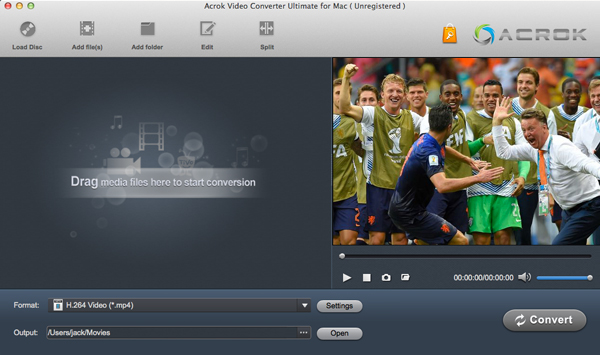
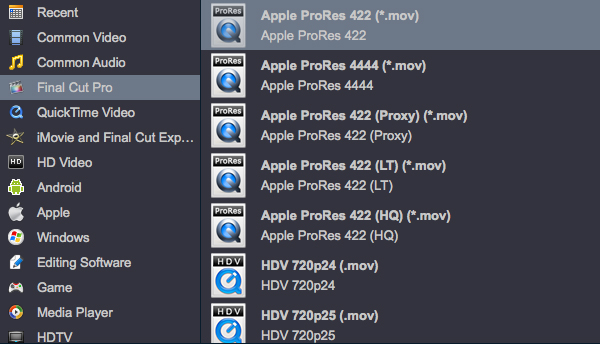
First, it handles MXF to ProRes 4444 and other editing codecs on macOS. If you prefer to create a controlled ProRes 4444 intermediate outside FCP—for archiving, for a Resolve round-trip, or for a client handoff—Acrok can transcode MXF sources to Apple ProRes 4444, ProRes 422 HQ, ProRes 422, and ProRes 422 Proxy in a MOV wrapper. It also converts to H.264, HEVC, and other common delivery formats. The output is designed for import into Final Cut Pro, DaVinci Resolve, and Premiere Pro without a second transcode.
Second, its disc decryption and conversion engine is the feature that distinguishes it from a plain video converter. Acrok Video Converter Ultimate for Mac can decrypt, rip, and convert protected Blu-ray and DVD discs that you own, including commercial discs with copy protection, and output them to ProRes, H.264, HEVC, MP4, MOV, MKV, and other formats. For a RED workflow, this is useful in two concrete situations: when a project references Blu-ray or DVD source material that needs to enter the same ProRes or H.264 timeline, and when a deliverable or archive copy has to be produced from a disc-based master. The disc-ripping path handles the decryption and conversion in one step rather than requiring a separate decryptor and a separate encoder.
Third, it is built for current Macs, not legacy ones. Acrok’s converter line runs on macOS 26 Tahoe and is positioned for macOS 27 Golden Gate compatibility, with Apple Silicon native support for hardware-accelerated encoding and decoding. That matters for ProRes 4444 work specifically: 4:4:4 intermediates are large, and hardware acceleration on M-series Macs keeps conversion times practical.
The honest framing is this: FCP remains the right place to edit native R3D, and Apple’s own optimized-media path remains the simplest way to create ProRes 4444 inside the NLE. Acrok Video Converter Ultimate for Mac is the companion tool for the work FCP does not try to do—controlled external MXF-to-ProRes 4444 transcoding, broad format conversion, and decryption/ripping of Blu-ray and DVD discs that need to join the same post-production pipeline.
The original page’s three-step structure needs to be rebuilt around the native-first principle. This version reflects what Final Cut Pro actually requires in 2026.
Step 1 — Identify what you have. Determine whether your files are R3D RAW or ProRes/DNxHD MXF proxies recorded by the RED camera. If they are MXF proxies, skip the R3D-specific steps and import them directly.
Step 2 — For R3D: install the RED Apple Workflow Installer and import natively. Download the installer from RED’s support site, install it, then import R3D files into FCP. Do not create optimized or proxy media during import if you intend to adjust RAW settings later.
Step 3 — Adjust RAW settings in the Inspector. Use the RED RAW controls to set ISO, exposure, and color temperature before you commit to any transcode. These settings can be revised non-destructively as long as you are working from R3D.
Step 4 — Decide whether to transcode. If performance or collaboration requires it, transcode to ProRes 4444 (for optimized quality), ProRes 422 HQ (for a lighter editorial intermediate), or ProRes 422 Proxy (for offline editing). You can do this inside FCP via optimized/proxy media creation, or externally with Acrok Video Converter Ultimate for Mac if you need a controlled ProRes 4444 intermediate before import.
Step 5 — If you are using an external converter for MXF to ProRes 4444, verify the source codec first. Only convert MXF files that are not already ProRes or DNxHD. Converting an already-ProRes MXF to ProRes again adds no quality and wastes time.
Step 6 — Bring disc-based material into the same pipeline if the project requires it. If the edit references Blu-ray or DVD source material, use Acrok Video Converter Ultimate for Mac to decrypt and rip the discs you own and convert them to the same ProRes or H.264 target used by the RED media. This keeps one consistent codec and one consistent timeline.
Step 7 — Edit, then relink if needed. Edit against ProRes proxies or optimized media, and relink to R3D for final grading in Resolve or for a native RAW export if the project requires it.
RED workflows in Final Cut Pro in 2026 require:
macOS: macOS 26.6 or later (macOS Tahoe). macOS 27 Golden Gate compatibility should be confirmed against the current FCP X release.
Processor: Apple Silicon (M-series) strongly recommended; native RED debayering and ProRes encoding are hardware-accelerated on Apple Silicon. Intel Macs remain supported up to macOS 26 Tahoe.
RAM: 16 GB recommended for R3D and ProRes 4444 workflows; 8 GB is the minimum for Final Cut Pro itself.
Storage: R3D files are compact relative to ProRes; ProRes 4444 intermediates require significantly more space, so plan storage accordingly.
Plugin: RED Apple Workflow Installer for native R3D import.
Companion converter (optional): Acrok Video Converter Ultimate for Mac for external MXF-to-ProRes 4444 transcoding, broad format conversion, and Blu-ray/DVD decryption and ripping on macOS 26 Tahoe and later.
Does Final Cut Pro need ProRes to edit RED MXF?
No. Final Cut Pro has supported native REDCODE RAW editing since 10.0.6, and ProRes or DNxHD MXF proxies recorded by RED cameras are already edit-friendly codecs. ProRes transcoding is an optional performance and collaboration choice, not a requirement.
When is RED MXF to ProRes 4444 the right conversion?
When you are starting from R3D and want the high-quality intermediate that Apple itself uses for “optimized media” in Final Cut Pro, or when you need 4:4:4 chroma and alpha support for finishing. It is not the right conversion for camera-generated ProRes MXF proxies, which are already ProRes.
Why does Apple recommend deselecting “Create optimized media” during R3D import?
Because if you adjust RAW settings after import, Final Cut Pro discards any transcoding done during import. To preserve RAW flexibility, import natively first, adjust RAW settings, and then transcode if needed.
What is the difference between R3D and RED MXF proxies?
R3D is RED’s proprietary RAW format, requiring debayering and supporting non-destructive RAW adjustments. RED MXF proxies are simultaneously recorded ProRes or DNxHD files in an MXF wrapper—already encoded, already edit-ready, and not RAW.
Can I edit R3D natively on a Mac without transcoding?
Yes. With the RED Apple Workflow Installer installed and a modern Apple Silicon Mac, native R3D editing in Final Cut Pro is fully supported. Transcoding is recommended for long-form or effects-heavy projects, but it is not a technical prerequisite.
Can Acrok Video Converter Ultimate for Mac decrypt and convert Blu-ray and DVD discs?
Yes. It is designed to decrypt, rip, and convert protected Blu-ray and DVD discs that you own to ProRes, H.264, HEVC, MP4, MOV, MKV, and other formats on Mac. That makes it useful when disc-based source material or disc-based masters need to enter the same RED-to-ProRes pipeline.
The correct workflow starts with a distinction that is routinely missed: R3D RAW and RED MXF proxies are different media types, and neither requires a mandatory ProRes conversion for Final Cut Pro. Native R3D editing has been available for over a decade, and RED’s camera-generated MXF proxies are already in ProRes or DNxHD. ProRes 4444 is a quality optimization for R3D—the codec Apple selects for optimized media in Final Cut Pro—not a universal first step. The workflow is built around native-first editing, optional ProRes transcoding by project need, and a clear R3D-versus-MXF distinction. Then add the part Final Cut Pro does not cover: Acrok Video Converter Ultimate for Mac for controlled MXF to ProRes 4444 transcoding and for decrypting, ripping, and converting Blu-ray and DVD discs on macOS 26 Tahoe and macOS 27 Golden Gate. That combination gives RED editors a workflow reference they can actually use in 2026—and a clear reason to keep the converter in their toolkit.


I like the product. I tried other products, but when I found it, I knew this video converter is perfect for me. Friendly interface, faster conversion speed, many useful profiles ...
Tonky
Copyright © 2026 Acrok Studio All Rights Reserved. Terms and Conditions | Privacy | Refund Policy